



Service Details
Service Description
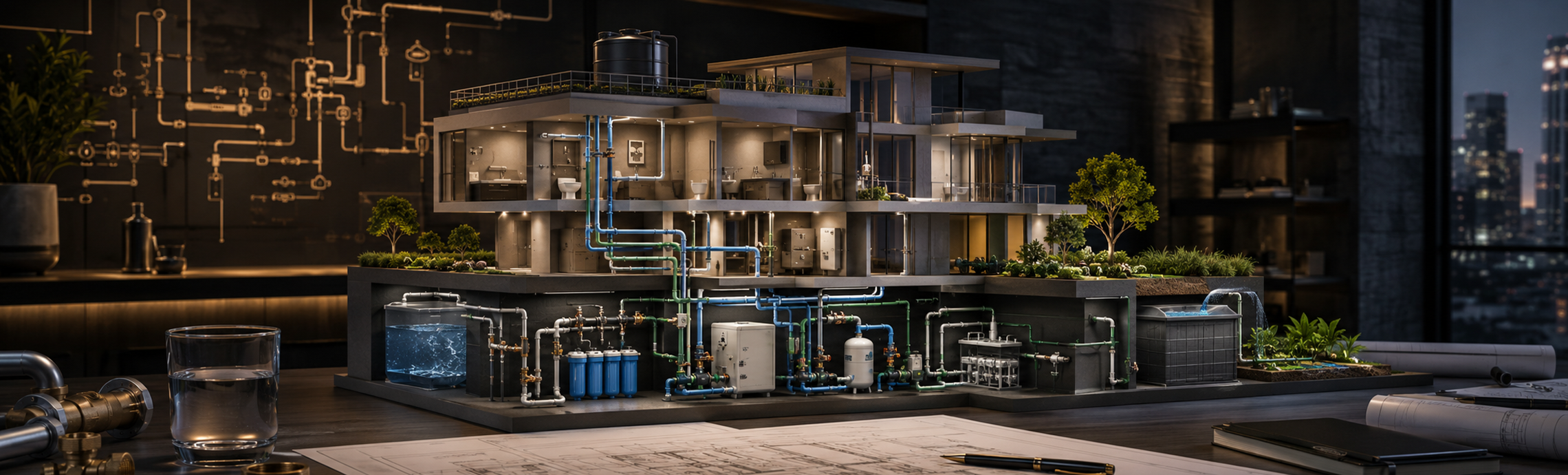
Sustainable plumbing engineering and water management help design more efficient and safer water supply and drainage networks, while reducing waste and improving operational quality inside residential and commercial buildings.
At Sila Al-Ebdaa, we provide engineering solutions that consider the nature of the project, usage requirements, sustainability, and long-term ease of maintenance.
Sustainable plumbing engineering and water management focus on designing organized networks that ensure water supply, drainage, and treatment work efficiently inside different types of buildings.
Designing cold and hot water supply networks.
Designing sanitary drainage networks and stormwater drainage when needed.
Defining pipe routes and distribution points inside the building.
Coordinating plumbing works with architectural, structural, and mechanical systems.
Considering easy maintenance and access to inspection points.
Sustainable plumbing engineering and water management depend on solutions that help reduce water consumption and improve network efficiency, especially in projects that require continuous operation. These standards include:
Choosing water-saving sanitary fixtures.
Reducing water loss through accurate network design.
Using control and monitoring systems when needed.
Studying water pressure and distributing it evenly.
Selecting materials that suit the nature of use and the local climate.
Sustainable plumbing engineering and water management are used in designing greywater reuse systems when the project is suitable for this type of solution, especially in large residential buildings, hotels, commercial complexes, and projects that aim to reduce water consumption and improve operational efficiency.
The design process starts by identifying greywater sources, such as washbasin water or other non-contaminated uses, while separating them from sewage water to ensure safe and organized handling.
Greywater collection points are defined inside the project, then the suitable treatment system is selected according to the usage volume and the required water quality for reuse.
After treatment, greywater can be directed to indirect uses such as irrigation for outdoor areas or suitable operational applications, while avoiding any use that may cause health risks.
The system is designed according to clear controls that prevent contamination or mixing between clean water networks and reused water networks, with separate labels and routes when needed.
Greywater system design differs from one project to another depending on the number of users, building type, expected water quantity, and the areas where treated water can be used.
The design must include clear inspection and maintenance points, so the operation team can monitor system efficiency and handle any issue before it affects network performance.
Sustainable plumbing engineering and water management consider the regulatory requirements related to drainage systems and water management to ensure safe, approvable, and executable design.
Complying with safety and health requirements in drainage networks.
Preventing any overlap between clean water and drainage networks.
Designing clear routes that reduce the possibility of leakage or blockage.
Considering suitable drainage methods according to the project type.
Preparing drawings in a way that supports review and approval.
Sustainable plumbing engineering and water management help reduce the building’s operational water consumption through smart solutions suitable for large and frequently used projects.
Using low-flow mixers and sanitary fixtures.
Applying leakage monitoring systems when needed.
Improving water pressure distribution inside the network.
Designing more efficient irrigation systems for outdoor areas.
Studying water reuse in suitable applications.
Sustainable plumbing engineering and water management support sustainability goals in modern projects because they are directly connected to water consumption efficiency and reducing the building’s environmental impact.
Reducing water consumption over the long term.
Improving operation and maintenance efficiency.
Supporting sustainable building requirements.
Reducing waste caused by inaccurate design.
Increasing project quality and operational value.
Sila Al-Ebdaa provides sustainable plumbing engineering and water management services for residential, commercial, hospitality, and administrative projects, with solutions suitable for each space and use.
Designing water supply and sanitary drainage networks.
Designing greywater reuse solutions when needed.
Reviewing drawings and reducing conflicts before execution.
Selecting suitable systems and materials according to project nature.
Preparing Bill of Quantities BOQ to clarify items and quantities and support cost estimation.
Providing clear drawings that help the execution team work accurately.
Plumbing design helps distribute water and drainage safely, reduce leaks and faults, and avoid costly modifications during execution.
Yes, some existing systems can be improved by using water-saving fixtures, improving pressure, or adding monitoring solutions according to the building condition.
No, it is not suitable for all projects. This depends on the building size, type of use, health requirements, and the possibility of executing a safe and effective system.
Please email us and our support staff will contact you back